
| Customer | Ethiopian Maritime Authority, Ministry of Transport & Logistics |
| Страна | Ethiopia |
| Site | Modjo Dry Port — Ethiopia's largest inland container port |
| Industry | Port & Rail Intermodal Logistics |
| Products Delivered | 2 × Rail-Mounted Gantry Cranes (RMG) + 3 × Rubber-Tyred Gantry Cranes (RTG) |
| Номинальная грузоподъемность | SWL 40 tons per crane |
| Проект | Modjo Dry Port Expansion Project |
| Milestone | First rail-mounted and rubber-tyred container gantry cranes ever commissioned in Ethiopia |
In September 2026, Weihua's rail-mounted container gantry cranes (RMG) and rubber-tyred container gantry cranes (RTG) were officially commissioned at Modjo Dry Port as part of the port's expansion project completion ceremony. The two RMG units and three RTG units together form the first complete set of container-yard gantry cranes ever put into service in Ethiopia, giving the country dedicated equipment for container stacking and rail-yard handling that previously didn't exist domestically.
The cranes were supplied and commissioned in step with Modjo Dry Port's expansion and modernization program, so they were ready to take over rail-to-yard container handling as soon as the upgraded facility opened.


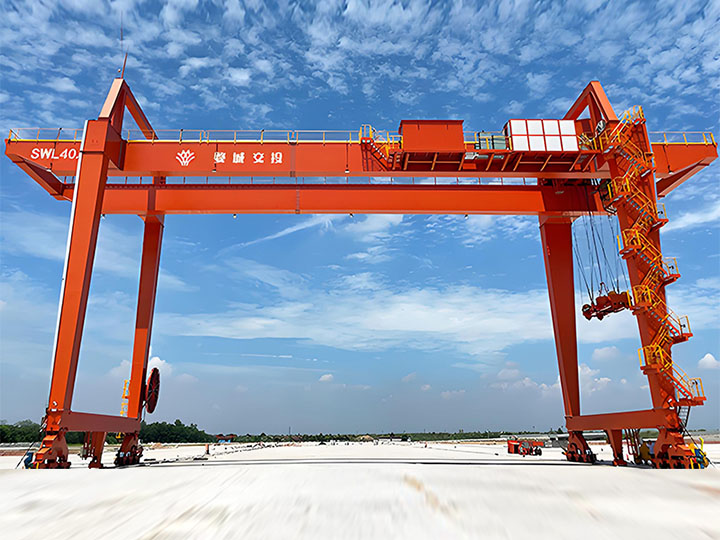
Weihua supplied two rail-mounted container gantry cranes rated at SWL 40 tons each. An RMG runs on fixed rails laid through the container yard, built around a box-girder main beam, rigid and flexible outriggers, a trolley travel mechanism, hoisting mechanism, and long-travel running gear. Because its travel path is fixed, an RMG holds tighter positioning tolerances than a rubber-tyred machine, which is why it's the standard choice for the rail-side transfer lane in an intermodal yard. Weihua's RMG range is available in single-cantilever, double-cantilever, or non-cantilever configurations to match different rail-lane and truck-lane layouts.


For reference, 40-ton-class RMG cranes in port and rail-yard service typically fall within these industry-standard parameter ranges:
| Параметр | Typical Range (40t Class) |
| Пролет | 35 m |
| Высота подъема | 18 m |
| Высота штабелирования | 1-over-3 to 1-over-5 containers |
| Рабочие обязанности | A8 |
| Spreader | Telescopic, 20ft / 40ft / 45ft |
| Cantilever | Single, double, or non-cantilever |
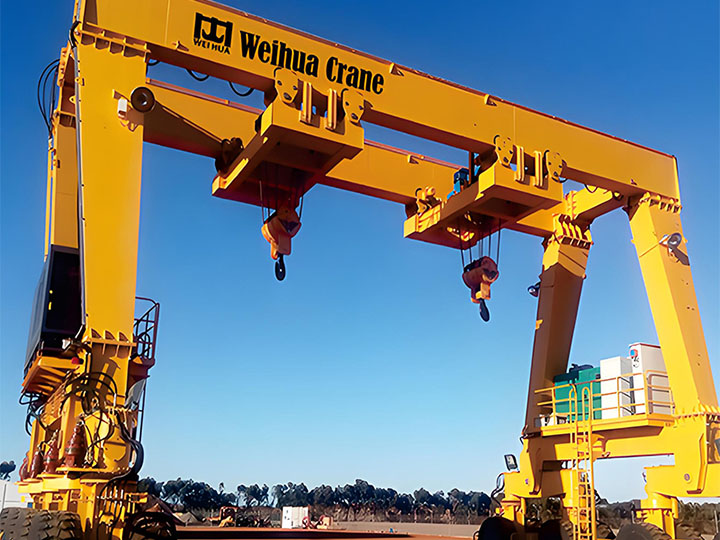
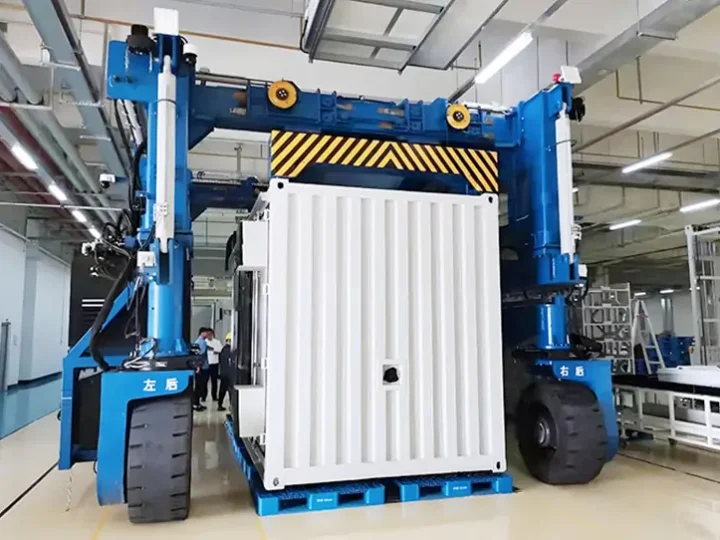
Weihua also supplied three rubber-tyred container gantry cranes, also rated at SWL 40 tons each. Unlike the rail-bound RMG, an RTG runs on rubber tires, so it isn't locked to a single travel path — it can reposition across rows and columns of the yard without laid track. That flexibility is especially useful on a yard still being reorganized during an expansion phase, or in operations where stacking patterns need to shift as container volumes grow. Weihua's RTGs are fitted with a telescopic container spreader for 20ft, 40ft, and 45ft boxes, along with automatic positioning and anti-sway control to keep stacking accurate at speed.


RTG Crane
Typical industry-standard parameters for 40-ton-class RTGs:
| Параметр | Typical Range (40t Class) |
| Пролет | 33 m (covers 6+1 or 7+1 lanes) |
| Высота подъема | 15 m |
| Высота штабелирования | Up to 1-over-6 containers |
| Рабочие обязанности | A8 |
| Drive Type | Diesel-electric, diesel-hydraulic, or fully electric |
| Wheel Configuration | 8 or 16 wheels |
At Modjo Dry Port, the RMG and RTG units cover the same core task from two different angles: moving containers between rail wagons and the storage yard. This rail-to-yard handoff is typically the tightest bottleneck at an inland port, and before this equipment was commissioned, Modjo had no gantry cranes purpose-built for that transfer. The two RMGs handle stable, high-frequency transshipment directly alongside the rail lines, while the three RTGs provide flexible coverage across the stacking blocks. Together, they close the gap between rail arrivals and departures and yard storage, improving import and export container distribution efficiency and customs clearance turnaround.
Modjo Dry Port is Ethiopia's largest inland port, handling the majority of the country's import and export cargo storage and transit. As a landlocked country, Ethiopia routes most of its foreign trade through the port of Djibouti, moving cargo inland along the Addis Ababa–Djibouti Railway to dry ports like Modjo for customs clearance, storage, and onward distribution.
Following this expansion and modernization, Modjo Dry Port is expected to further unlock capacity along the Addis Ababa–Djibouti Railway trunk line, reduce inland transit costs, and support industrial development and employment growth in Modjo and the surrounding area.
For Weihua, the Modjo Dry Port delivery is more than a routine export order — it's a strategic foothold in Ethiopia and a further step in the company's overseas expansion. It builds on Weihua's port-crane experience and turns it into on-the-ground delivery capability, with continued participation in the Addis Ababa–Djibouti Railway economic corridor and Ethiopia's broader logistics infrastructure ahead.
"Modjo Dry Port is not just another delivery for Weihua — it's a new strategic anchor point as we deepen our presence in Ethiopia and accelerate our push overseas. Going forward, we'll keep turning our port-crane expertise into real, on-the-ground delivery capability, and stay closely engaged with the Addis Ababa–Djibouti Railway corridor and Ethiopia's wider logistics build-out — bringing more high-quality Chinese-made equipment to the region." — Weihua Group, Overseas Business Division
Weihua Group is a leading Chinese manufacturer of cranes and lifting equipment, serving ports, terminals, railways, and heavy industry customers around the world. Weihua's port-handling lineup includes rail-mounted gantry cranes (RMG), rubber-tyred gantry cranes (RTG), ship-to-shore cranes, and container gantry cranes, backed by global engineering, installation, and after-sales support. For project-specific inquiries, contact Weihua's overseas engineering team through weihuaglobal.com.
The RMG (rail-mounted gantry crane) runs on fixed rails and handles the direct rail-to-yard container transfer, while the RTG (rubber-tyred gantry crane) moves freely on rubber tires to stack and reposition containers across the yard. Modjo Dry Port uses both together to cover rail-side handling and yard flexibility.
The two RMG and three RTG units are the first rail-mounted and rubber-tyred container gantry cranes ever commissioned in the country, giving Ethiopia dedicated container-yard handling equipment that previously didn't exist domestically.
All five units — the two RMGs and three RTGs — are rated at SWL 40 tons.
Отправить запрос
