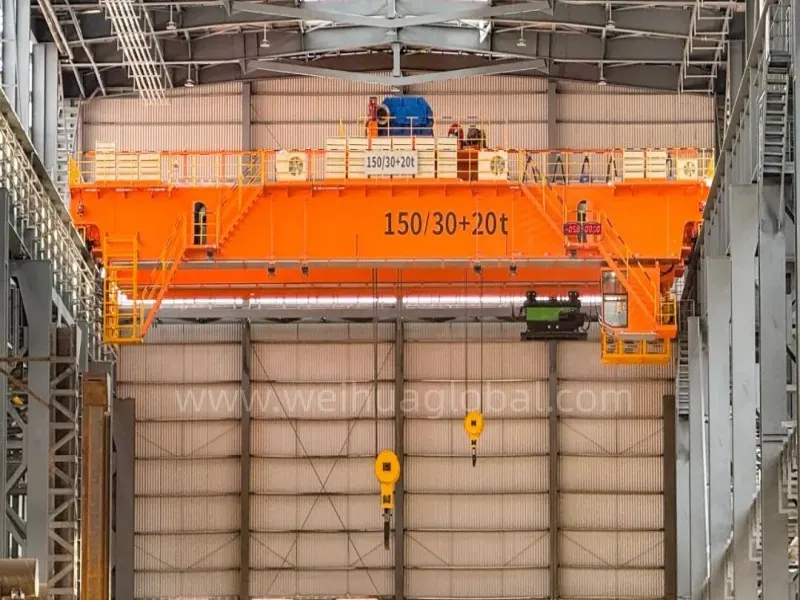
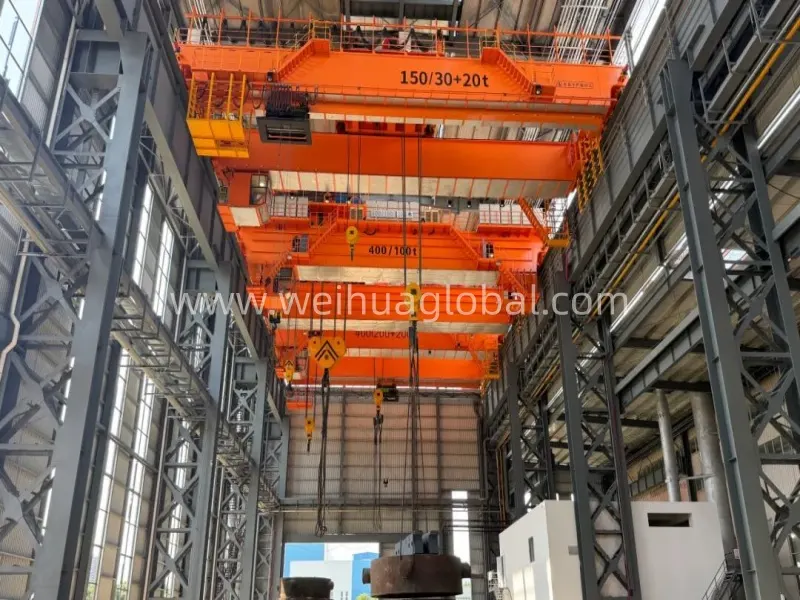
Summary: Weihua delivered two double girder quenching overhead cranes, 400 tons and 150 tons, to a heat treatment manufacturer in Vietnam. The 400-ton unit is reported to be the largest-capacity quenching crane in the country. Both cranes work on the same production line.
| Objet | Détails |
| Destination | Vietnam |
| Client | Heat treatment manufacturer |
| Equipment | Double girder quenching overhead cranes |
| Quantité | 2 sets |
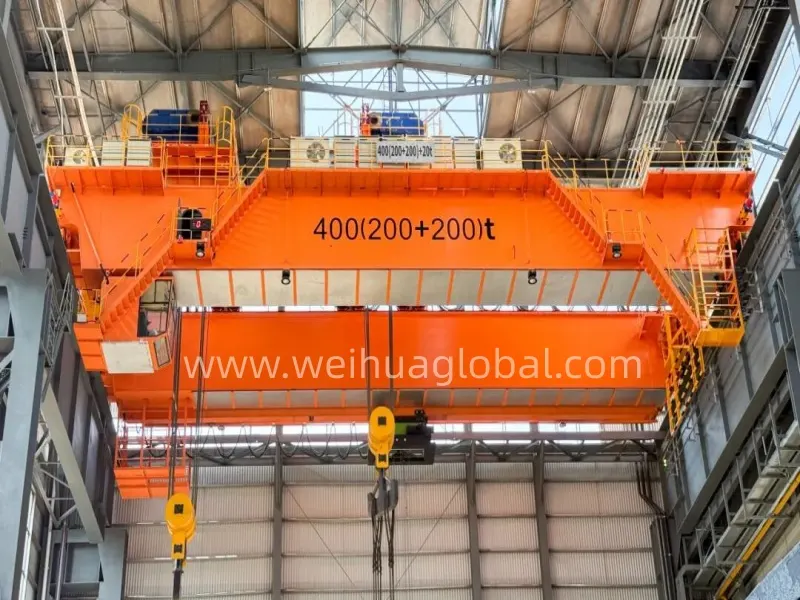
| Crane 1 | 400(200+200)+20t |
| Crane 2 | 150/30+20t |
| Application | Heavy workpiece quenching and handling |
| Duty class | A7 |
| Contrôle | PLC centralized control; stator voltage speed regulation on main hoist |
| Delivery | 2026 |
Both cranes are installed and in service. Together they handle heavy workpieces through the full quenching sequence, from furnace to quench medium.
A quenching crane moves a hot workpiece from the furnace into the quench medium, usually water, brine or oil. The typical sequence is:
Speed, timing and load stability decide the quality of the result. A slow or swinging entry can cause uneven structure or surface damage. This is why a quenching crane is a special-duty machine and not a standard overhead crane.
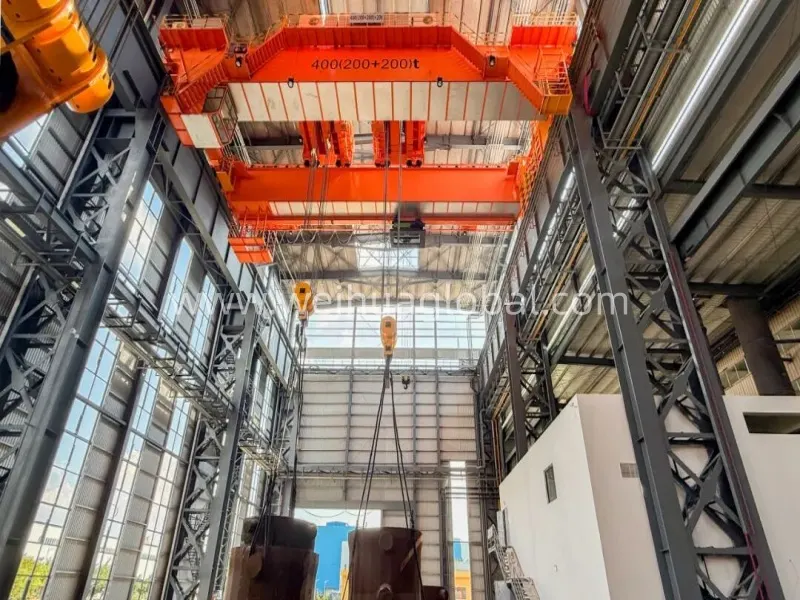
These measures keep heat away from core electrical and control components. They target the typical high-temperature faults, such as cable ageing and unstable signals, so the cranes can run long continuous shifts.
Both cranes use a latest-generation PLC centralized control system. The main hoist uses stator voltage speed regulation, so the system can coordinate the acceleration and deceleration curves of the main and auxiliary hooks. This gives:
| 400 Ton Crane | 150 Ton Crane | |
| Marking | 400(200+200)+20t | 150/30+20t |
| Levage principal | Two 200 t hoisting units | 150 t main hoist |
| Other hoists | 20 t hoist | 30 t and 20 t units |
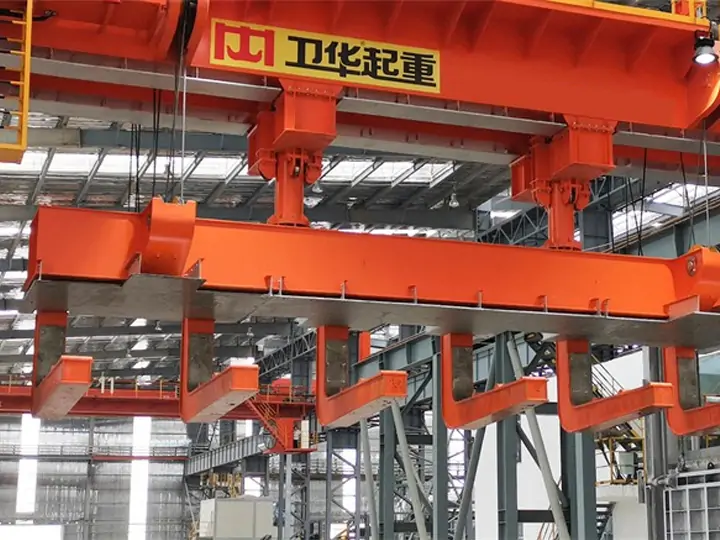
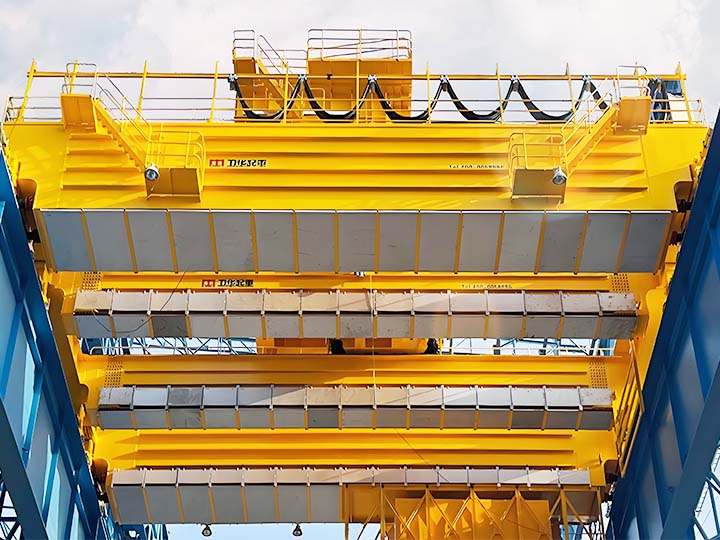
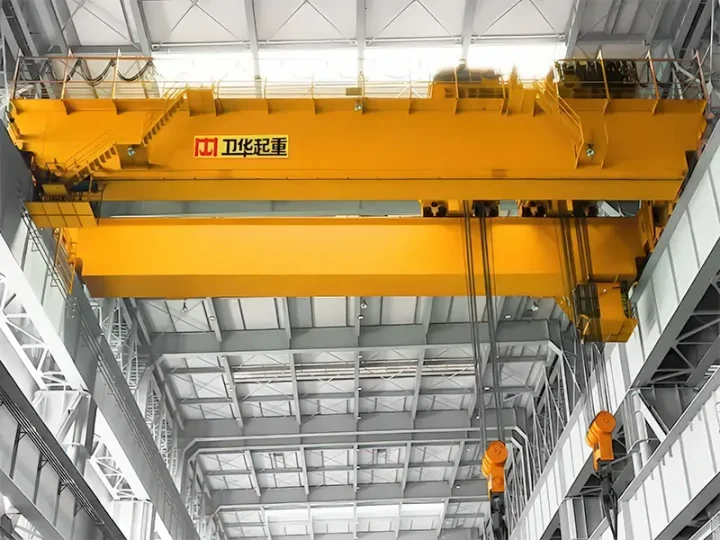
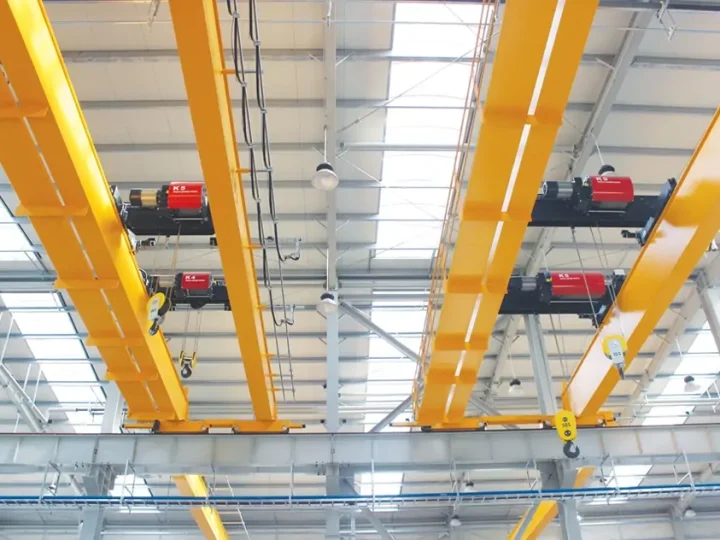
| Structure | Box-type double girder with walkways and access stairs | Box-type double girder with walkways and access stairs |
Hoist roles follow the markings on the girders. Final configuration details are confirmed in the project design.
| Paramètres | Typical Range |
| La portée | 28 m |
| Hauteur de levage | 25 m |
| Obligation de travail | A7 |
“Quenching leaves little room for error. We designed these cranes around heat protection and coordinated hook control, so the customer’s line can run steadily with heavy workpieces.”
— Weihua Group, Overseas Business Division
What is a quenching overhead crane?
It is a special-duty overhead crane that moves hot workpieces from a furnace into a quench medium on a controlled schedule.
Why does a quenching crane need heat protection?
Furnace radiation can age cables and disturb signals. Heat-resistant cables, an insulated electrical room and a cab reduce these risks.
Can one crane lift 400 tons with two 200-ton hoists?
A 400(200+200)t marking means two 200-ton hoisting units form the 400-ton main lift. The exact lifting method follows the crane’s design and rated load table.
What information is needed for a quotation?
Workpiece weight, furnace temperature, quench medium, span, lifting height and duty class.
Send us your requirements and our engineers will propose a configuration.
→ Pont roulant de trempe pour une aciérie
→ Pont roulant à double pont
→ Request a Quote
→ WEIHUA vous invite à VINAMAC EXPO 2026 à Hô Chi Minh-Ville – Visitez le stand B310

Senior Crane Specialist / Technical Advisor
Online SupportOver 10 years of experience in overhead & jib crane solutions. Dedicated to helping global clients find the most efficient and cost-effective lifting equipment.
Soumettre une demande