
Industry News
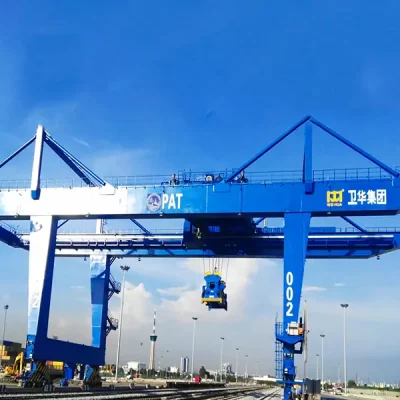
Rubber-tired gantry cranes (RTGs) are large pieces of equipment responsible for stacking, transferring, and loading/unloading containers, and are widely used in ports, container yards, and intermodal hubs. They can freely adjust their operating paths based on container stacking conditions, significantly improving site utilization and operational flexibility.
However, with the global trend towards decarbonization, fluctuating energy prices, and the demand for automation, traditional diesel-powered RTGs face challenges, making electrification and hybrid power important directions. This article aims to systematically analyze the advantages and disadvantages of these three power solutions, providing a reference for decision-makers.
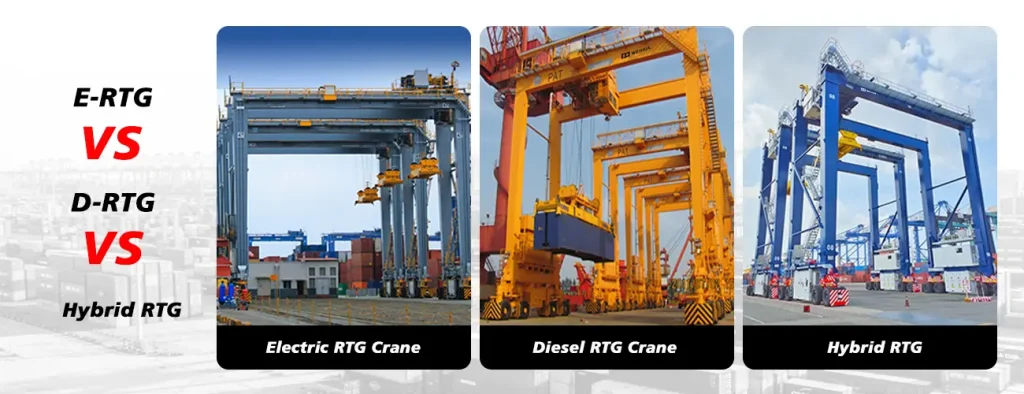
Diesel-powered RTG cranes are a mature and widely used traditional solution. At its core is an integrated on-board diesel generator set, forming a completely self-contained "mobile power station." The crane itself does not rely on any external fixed power source.
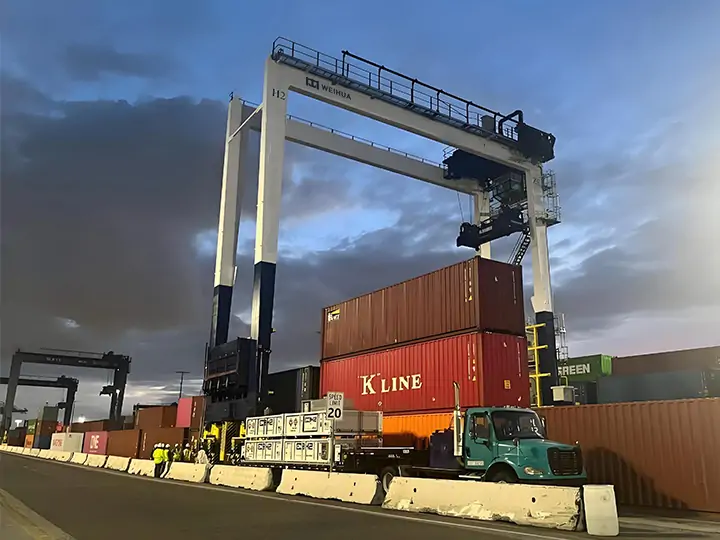
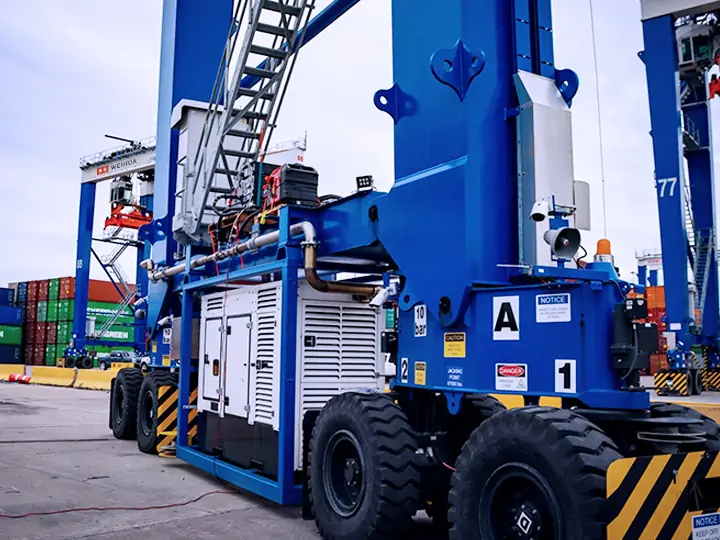
Energy Generation: A diesel engine drives a generator, converting the chemical energy of the fuel into electrical energy.
Distribution: The generated electricity directly powers the various working mechanisms of the crane (hoisting, trolley movement, gantry travel, and steering).
Dissipation: When the container is lowered, the drive motor acts as a generator, producing regenerative electrical energy. In traditional diesel RTGs, this energy is usually not effectively utilized and is dissipated as heat through a braking resistor unit, resulting in energy waste.
Advantages: Offers absolute operational freedom and mobility. It does not require connection to an external power grid and can be flexibly and quickly moved between different container stacks at any location in the yard, with very low dependence on infrastructure.
Disadvantages: Low energy utilization efficiency (overall energy conversion efficiency is approximately 35%-45%), resulting in high energy consumption costs per operation. At the same time, its continuous operation produces significant exhaust emissions of carbon dioxide, nitrogen oxides, and particulate matter, as well as high noise levels, making it a major source of pollution and carbon emissions in the container yard.
The fully electric RTG crane completely eliminates the on-board diesel generator set and instead obtains power directly from the port/yard's fixed power grid through facilities such as cable reels, overhead contact lines, or rigid contact systems.
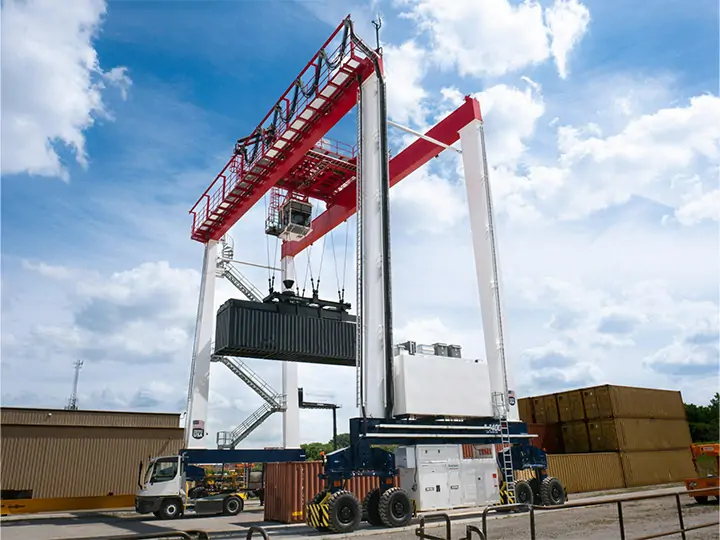
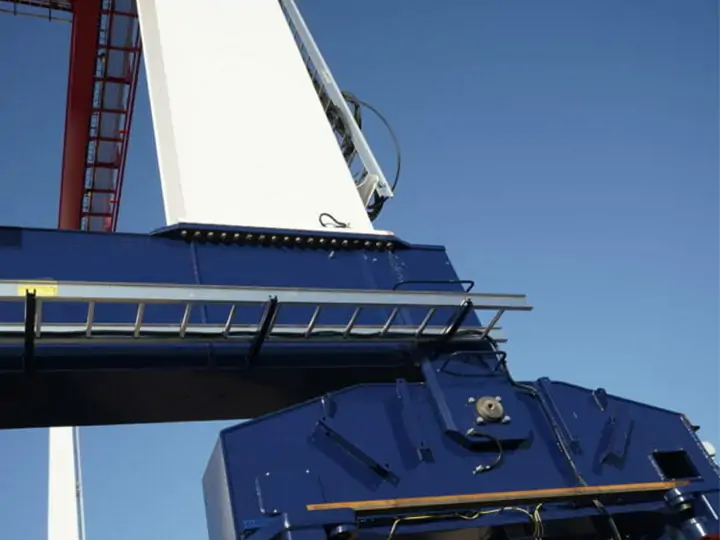
Energy Input: Electricity is continuously supplied to the crane from the external power grid through dedicated power supply facilities.
Drive and Regeneration: The power from the grid drives the motors of each mechanism. Crucially, the regenerative energy generated when the container is lowered or the equipment decelerates can be fed back to the power grid through a power electronic system, for use by other equipment or for storage, achieving energy recovery.
Operating Mode: The entire process is electrically driven, with no local combustion emissions during operation.
Advantages: Zero emissions at the work site, significantly reduced noise levels. Energy costs are significantly lower than diesel, and the electric drive system has a simple structure, resulting in low maintenance workload and costs. High overall energy utilization efficiency, with regenerative energy being recovered and reused.
Disadvantages: The operating range is strictly limited by the coverage area of the power supply facilities. Long-distance transfers across different areas require complex cable management or switching of power supply points, limiting flexibility. Furthermore, the initial investment is significant due to the need to build a complete power supply network.
The hybrid RTG crane is based on a diesel-powered system, with the addition of an energy storage system (usually a lithium-ion battery pack or supercapacitor), forming a composite power architecture of "diesel generator set + energy storage unit." Its design goal is not to achieve full electric operation, but rather to significantly optimize energy efficiency while retaining the mobility of the diesel engine.
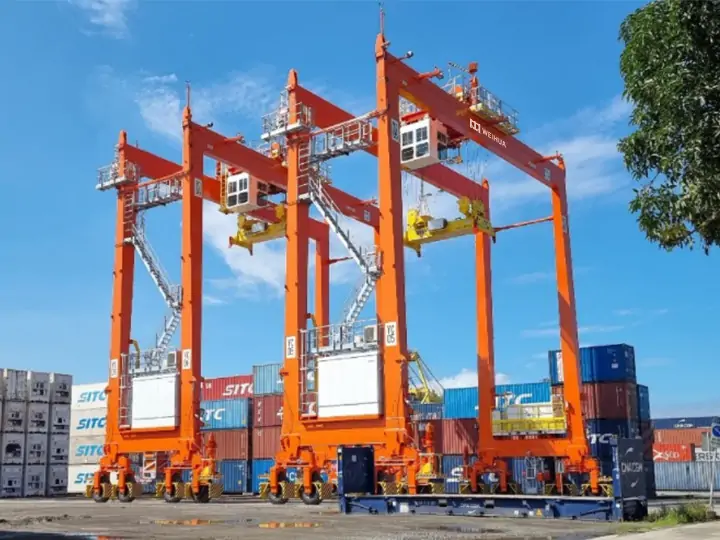
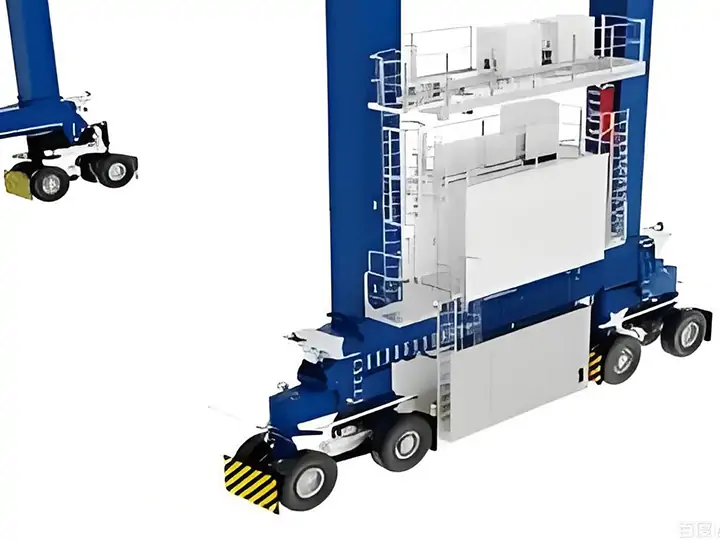
Diesel Engine Optimized Operation: The diesel engine operates as much as possible within its efficient and stable load range, charging the battery pack or providing power in conjunction with the battery.
Energy Storage System's Core Function: Absorbs and stores regenerative energy during braking. During peak power demands such as lifting, it operates in parallel with the diesel engine, reducing diesel engine load fluctuations; during low demand periods, it can independently power the equipment for short periods. It provides power during non-precision operations such as repositioning.
Operating Modes: Intelligently switches between pure electric mode, diesel engine-only drive mode, combined drive mode, and charging mode depending on the operating conditions.
Advantages: Through energy recovery and optimized diesel engine control, it can achieve a 30%-50% fuel saving rate, correspondingly reducing emissions and noise. It does not rely on an external power grid, retaining almost the same repositioning flexibility as a diesel RTG. It is particularly suitable for yards with environmental requirements but inadequate power supply infrastructure, or those with flexible and varied operating modes.
Positioning: It is both the most cost-effective transitional solution for green upgrades of existing diesel RTGs and an ideal long-term solution for specific complex operating scenarios.
The table below provides a comprehensive and professional comparative analysis of three mainstream power types of rubber-tyred gantry cranes (diesel-powered, pure electric, and hybrid) across multiple key dimensions, offering clear decision support for equipment selection.
| Dimension | Diesel-Powered RTG | Pure Electric RTG | Hybrid-Powered RTG |
| Power System & Working Principle | Independent "Mobile Power Station". Equipped with an onboard diesel generator set, providing fully self-sufficient energy with no reliance on an external power grid. | Efficient "Grid Connector". Draws electricity directly from an external power grid via cable reel, conductor rail (busbar), or overhead contact line systems. | Intelligent "Balancing Master". Utilizes a composite power architecture of "Diesel Generator Set + Energy Storage System (Lithium Battery/Supercapacitor)". |
| Core Advantages | 1. Superior Mobility: Unrestricted by power supply range 2. High Independence: Zero dependence on infrastructure 3. Low Initial Investment: Lowest equipment procurement cost 4. Mature Technology: Extensive operational experience | 1. Lowest Operating Cost: Electricity costs significantly lower than diesel 2. Zero On-site Emissions: No exhaust fumes and extremely low noise 3. Simple Maintenance: Reduce maintenance costs by ~70% 4. Best Suited for Automation: Stable power supply and precise control | 1. Significant Energy Saving: Achieves 25%-40% fuel saving 2. Maintains Good Flexibility: Near-diesel RTG mobility 3. Wide Applicability: Ideal for diesel equipment retrofit |
| Main Disadvantages | 1. High Operating Costs: Affected by oil price volatility 2. Severe Environmental Impact: Major source of emissions and noise (85-95 dB) 3. Complex Maintenance: Frequent servicing required 4. Automation Challenges: Difficult integration | 1. Highest Initial Investment: Requires complete power infrastructure 2. Limited Operational Flexibility: Confined to power supply area 3. High Grid Dependency: Power outages halt operations 4. Battery Sensitivity: Affected by extreme temperatures | 1. Most Complex System: Two power systems increase complexity 2. Moderate Initial Cost: Higher than diesel, lower than full electric 3. Not Ultimate Zero-Carbon: Still depends on diesel 4. Transitional Technology Risk: May be intermediate solution |
| Economic Dimension | Diesel-Powered RTG | Pure Electric RTG | Hybrid-Powered RTG |
| Total Cost of Ownership (TCO) | Low initial investment, high operating cost | High initial investment, low operating cost | Moderate initial and operating costs |
| Cost Structure | • Initial: Lowest procurement cost • Operating: High (fuel + maintenance) • Environmental: Future carbon costs may apply | • Initial: Highest (equipment + infrastructure) • Operating: Lowest (electricity + low maintenance) • Environmental: Minimal regulatory risks | • Initial: Moderate (retrofit cost for existing) • Operating: Reduced by 25%-40% fuel saving • Environmental: Partial compliance benefits |
| Return on Investment | Poor long-term economics Economic viability deteriorates with rising oil prices and environmental cost internalization | Excellent long-term economics Typical payback period: 3-5 years Clear lifecycle economic advantages | Balanced economics Payback period shortened through fuel-saving benefits Pragmatic choice for budget constraints |
| Cost Risk Factors | • Oil price volatility • Carbon tax imposition • Increasing maintenance costs | • High upfront capital requirement • Infrastructure dependency • Battery replacement costs | • System complexity maintenance • Technology obsolescence risk • Limited emission reduction potential |
| Strategic Dimension | Diesel-Powered RTG | Pure Electric RTG | Hybrid-Powered RTG |
| Market Positioning | Facing phase-out pressure Traditional solution with shrinking market share in green transition | Clear mainstream direction Core equipment for modern smart terminals and sustainable ports | Crucial transitional solution Adaptive technology balancing current needs and future requirements |
| Future Viability | • Limited to special scenarios demanding extreme mobility • Potential transition to alternative fuels (biodiesel) • Decreasing regulatory acceptance | • Flexibility shortcomings being addressed through technology advancements • Integration with renewable energy sources • Standard for new terminal developments | • Most cost-effective upgrade path for existing diesel fleet • Scenario-adaptive solution for varied operational needs • Bridge technology during infrastructure development |
| Technology Evolution | Mature technology with limited innovation path Mainly incremental improvements in fuel efficiency | Rapidly advancing technology • Battery technology improvements • Fast-charging/battery-swapping models • Renewable energy integration | Optimization-focused development • Improved energy management systems • Enhanced battery performance • Better system integration |
| Strategic Recommendation | Short-term necessity only For budget-constrained projects or sites with no power infrastructure | Long-term strategic investment For new terminals, automation projects, and sustainability-focused operators | Practical interim solution For existing operations seeking immediate improvement while planning future upgrades |
If you are pursuing maximum operational efficiency, zero emissions, and integrated automation, all-electric rubber-tired gantry cranes (E-RTGs) are your strategic choice.
For those with limited budgets but requiring highly flexible equipment, diesel-powered rubber-tired gantry cranes remain a viable option, offering independent power supply, which is crucial in certain scenarios. However, choosing diesel-powered equipment requires a proactive assessment of the operational risks posed by future environmental regulations.
Looking for the optimal balance between mobility, cost, and environmental performance?Or planning to upgrade existing diesel equipment with a more environmentally friendly solution? Hybrid rubber-tired gantry cranes offer an ideal transitional solution, maintaining operational flexibility while significantly reducing fuel consumption and emissions.
The final decision should be based on detailed operational data analysis, on-site infrastructure assessment, cost calculations, and a clear long-term development strategy.
Diesel-powered RTG cranes are a practical choice when budgets are limited and maximum flexibility is required, while fully electric RTG cranes represent a long-term strategic investment for those pursuing zero emissions, low operating costs, and automation. Hybrid RTG cranes offer an optimal compromise between the two. Choosing the right RTG power mode depends on a thorough analysis of your operational patterns, financial situation, site conditions, and development strategy. Port managers need to remain technologically aware, establish flexible equipment upgrade strategies, and seize opportunities in the wave of green transformation to build future core competitiveness.
If you require RTG crane equipment solutions, please feel free to contact us.
Submit Request
 EN
EN  AR
AR  ES
ES  FR
FR  PT
PT  IT
IT  MN
MN  RO
RO  TR
TR