
Nouvelles de l'industrie
Container shuttle carriers are vital machines in logistics and construction. They lift and move heavy loads, helping operations run more efficiently. You will find them at work in many places, such as:
This article explains:
You will get a clear and quick overview of this important equipment. Please continue reading:
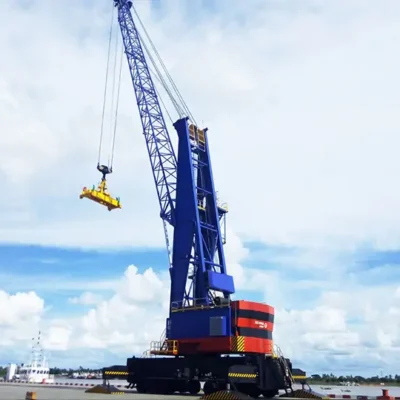
A container shuttle carrier is also called a straddle carrier. This is a type of specialized handling equipment. It is mainly used in ports, container yards, and logistics centers. It loads, unloads, stacks, and moves containers within these facilities.
Its design has a key feature: it “straddles” containers. The machine rides over a container. It uses a hydraulically or electrically operated spreader. The spreader grips, lifts, carries, and places the container. This design allows the equipment to handle containers efficiently and flexibly. It can operate even in tight spaces. This makes the container shuttle carrier essential in modern container logistics.
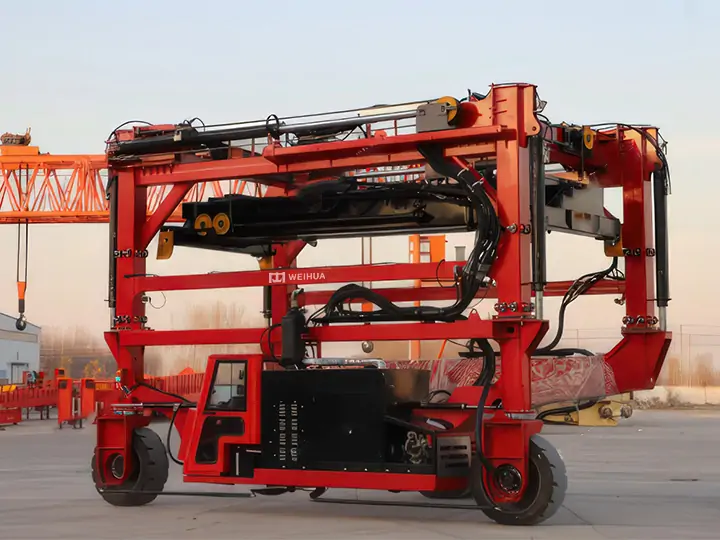
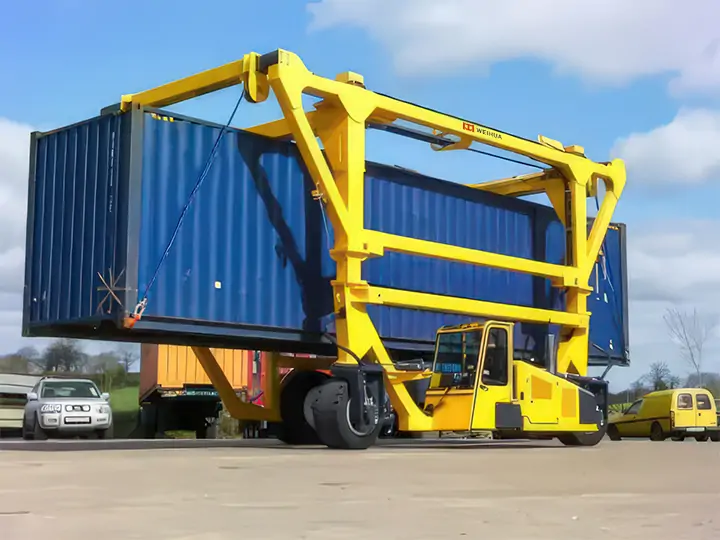
Container Shuttle Carriers are primarily composed of the following core components:
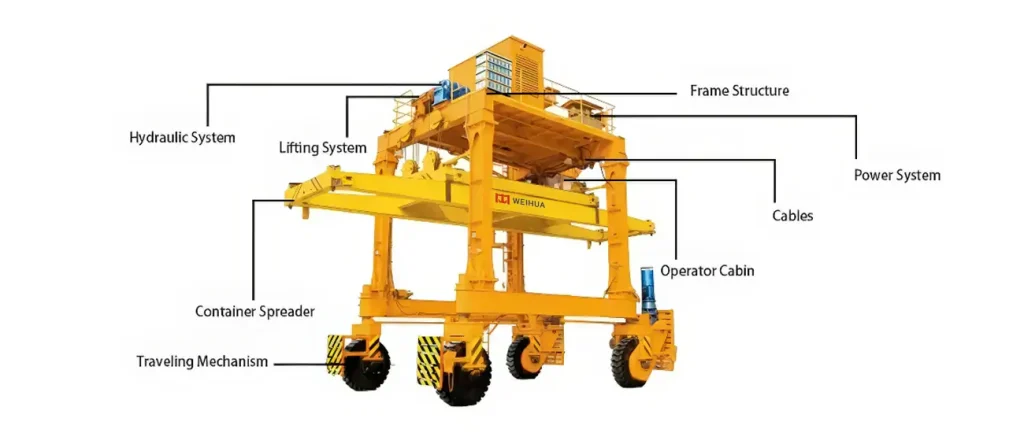
Chassis and Gantry: The overall load-bearing structure, providing stable support and enabling "container straddling" operations.
Power System: Diesel engine or electric drive, providing power for driving and hydraulic functions.
Lifting Mechanism and Spreader: Hydraulic or electric lifting device, working with twist locks on the spreader to grasp and lock containers.
Hydraulic System: Controls lifting, steering, and other movements, ensuring smooth and precise operation.
Driving and Steering System: Large-sized tires combined with flexible steering, suitable for narrow spaces in the container yard.
Cab and Control System: Integrated operating interface and electronic control unit, enabling human-machine interaction and safety monitoring.
Safety System: Includes anti-collision, limit switches, and alarm devices to ensure safe operation.
The container shuttle carrier performs specialized work. It transports containers horizontally and stacks them. Its core working principle follows a cycle. First, the carrier straddles a container and grips it. Next, it lifts the container vertically. Then, it transports the container horizontally. Finally, it places the container precisely.
Positioning and Gripping: The vehicle drives to a position directly above the container, and the hydraulic or electric spreader aligns with the four corner fittings on the top of the container. The twist locks on the spreader automatically rotate and lock, achieving a secure connection with the container.
Lifting and Transport: After locking, the lifting system (hydraulic or electric) starts, smoothly lifting the container vertically to a safe transport height. Then, the vehicle, powered by its drive system (diesel, hybrid, or pure electric), moves the container to the target location.
Placement and Release: Upon reaching the designated location (such as a stacking yard, truck, or ship loading/unloading point), the lifting system slowly lowers the container, precisely placing it in position. The spreader's twist locks unlock, and the vehicle moves away, completing one operation cycle.
The operator sits in the cab above the vehicle frame throughout the entire process. This position gives them a wide field of view. Using the control system, the operator monitors the spreader's status, lifting height, and vehicle operation in real time. This ensures safe and precise handling.This real-time monitoring ensures safe and precise operation.
Spreader System: As the direct operating mechanism, it can adapt to different sizes of containers. Advanced models are equipped with double spreaders, allowing for the simultaneous handling of two 20-foot containers.
Drive and Steering System: Straddle carriers are highly maneuverable. In addition to conventional forward movement, they typically have the ability to move diagonally ("crab steering") and even rotate in place, to adapt to efficient turnaround in narrow yards.
Control System:
Manual Mode: The operator directly controls all movements through joysticks, buttons, etc., suitable for complex working conditions.
Automatic/Remote Mode: Utilizing laser navigation, GPS, and sensors, it receives instructions from the terminal operating system (TOS) to achieve automatic path planning, obstacle avoidance, loading, unloading, and stacking. Operators can also remotely monitor and control multiple devices.
Unique Straddle Structure: Utilizing a high-strength steel gantry frame, it can stably straddle containers for operation, providing a robust structure and strong load-bearing capacity.
Integrated Operating Functions: It integrates container grasping, vertical lifting, and short-distance horizontal transportation functions, allowing one machine to complete the entire "grasp, lift, transport, and place" process.
Excellent Maneuverability: Features multi-mode steering capabilities (such as front-wheel steering, all-wheel steering, "crab" diagonal movement, and on-the-spot rotation). The relatively compact body requires a small aisle width (as narrow as 1.6-1.8 meters), allowing it to move flexibly in narrow and congested yards.
Advanced Intelligent Control: Supports manual, automatic, and remote control modes. Integrating laser navigation, GPS, and sensors, it enables automatic path planning, precise positioning, and obstacle avoidance, making it a key piece of equipment for automated terminals.
Green Power System: The power system is transitioning from traditional diesel drive to hybrid and pure electric power, effectively reducing emissions and noise.
Comprehensive Safety Design: Equipped with active safety systems such as anti-collision, load monitoring, and emergency braking.
The driver's cab is ergonomically designed, improving operator comfort and sustained work capacity.
Integrated Operations: Reduces reliance on multiple pieces of equipment and simplifies processes.
Reduced Turnaround Time: As an operational hub connecting ships, yards, and trucks, it effectively links each stage, shortening ship time in port and truck waiting times.
Decoupled Operations: Allows quay cranes to focus on ship loading and unloading, while straddle carriers handle horizontal transport and yard operations, improving the utilization rate of large equipment.
High-Density Stacking: Can stack 3-4 layers of containers, significantly increasing vertical yard space utilization (up to 20%-30%).
Excellent Site Adaptability: With superior maneuverability, it can operate efficiently in irregularly laid out or space-constrained terminals.
Reduced Equipment Investment and Maintenance Costs: The integrated multi-functionality reduces the need for additional cranes and horizontal transport equipment.
Flexible Deployment: Can be quickly deployed to different areas of the terminal according to operational needs, optimizing asset utilization.
Improved Safety: The stable structure and multiple safety systems reduce the risk of accidents.
Contribution to Sustainable Development: Hybrid and electric models reduce carbon emissions and noise pollution, helping terminals achieve environmental goals.
Classified by power system, this is the most crucial classification method, directly determining the equipment's performance, operating costs, and environmental impact.
Working Principle: Powered by a diesel engine, driving the vehicle through mechanical transmission.
Key Features: Powerful, long operating range, low dependence on infrastructure.
Applicable Scenarios: Suitable for locations requiring long-term continuous operation, heavy-duty conditions, or where electrical infrastructure is inadequate, such as large logistics parks, remote port areas, and heavy industrial plants.
Advantages: Mature technology, relatively simple maintenance; quick refueling, high operational continuity; strong adaptability to complex terrain.
Disadvantages: Generates exhaust emissions and significant noise; operation is affected by fuel price fluctuations; does not comply with increasingly stringent environmental regulations.
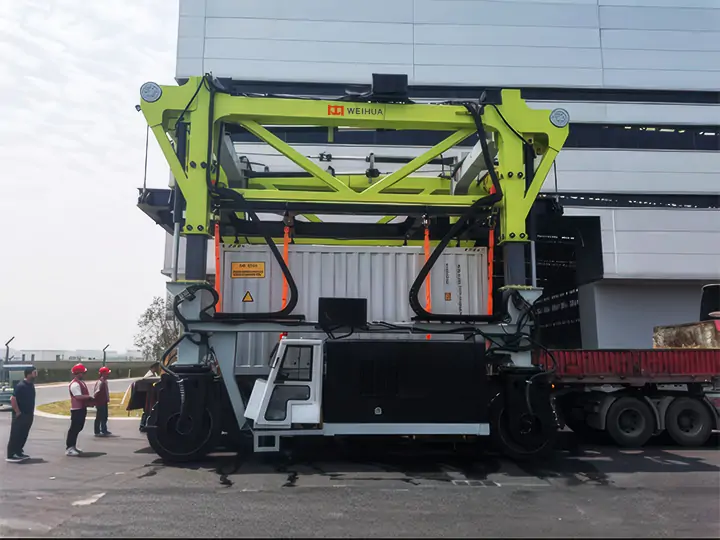
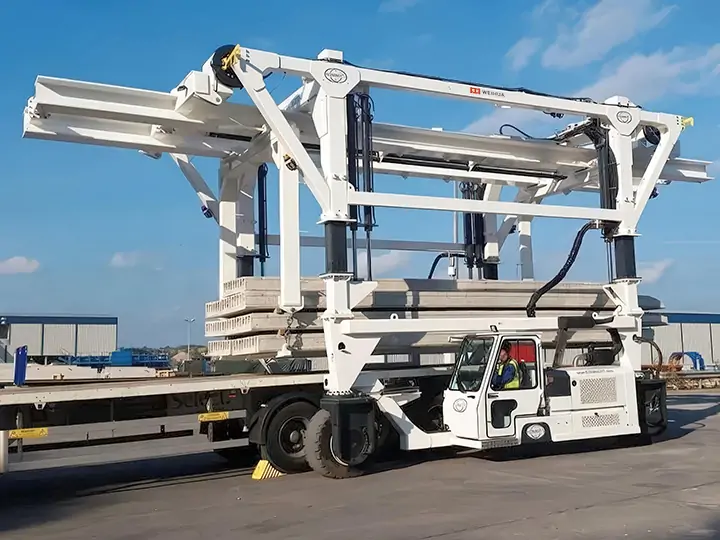
Working Principle: Powered by a battery, which drives an electric motor. Based on battery technology, there are two main types:
Lead-acid battery type: Traditional technology, lower cost, but the battery is heavy and has low energy density, with a typical operating time of 4-6 hours.
Lithium-ion battery type: Modern mainstream technology, high energy density, lightweight, supports fast charging, and can operate for 8-10 hours, often equipped with an energy recovery system.
Core Features: Zero emissions, low noise, high energy efficiency.
Applicable Scenarios: Areas with high environmental and operational requirements, such as indoor warehouses, urban ports, automated terminals, and industrial parks with strict environmental regulations.
Advantages: Environmentally friendly and quiet operation; electricity operating costs are usually lower than diesel; relatively less maintenance required.
A container shuttle carrier has several disadvantages. Its initial investment is higher, especially for the lithium-ion type. The battery limits the operating range. Operators must plan for charging facilities. They must also plan for battery replacement facilities. Extreme temperatures may degrade the carrier's performance.

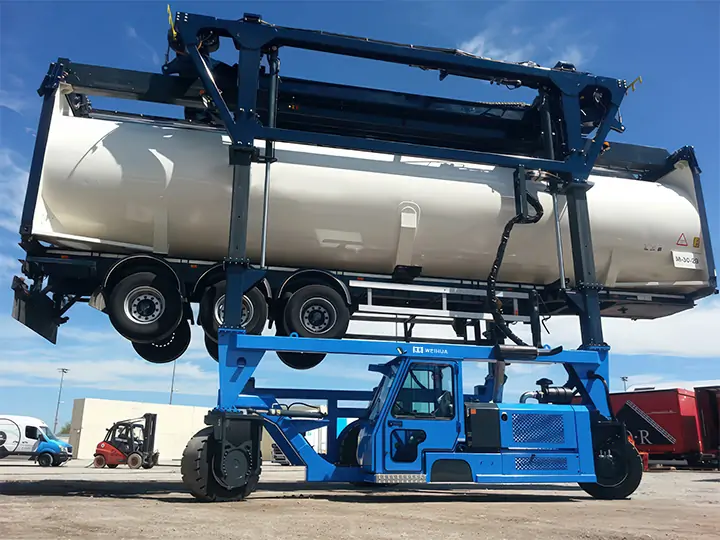
Working Principle: Combines a diesel engine and an electric system, typically switching intelligently between pure electric, diesel, or hybrid modes to achieve optimal energy efficiency.
Key Features: Combines the long operating range of a diesel engine with the environmental and energy-saving advantages of electric power, representing an important step towards a fully electric transition.
Applicable Scenarios: Suitable for ports or logistics centers that require extended operating times and also wish to gradually reduce emissions and fuel costs.
Advantages: Significantly reduces fuel consumption and emissions (up to 40% savings compared to traditional diesel engines); offers good flexibility and is less dependent on charging infrastructure than pure electric vehicles.
Disadvantages: The system is more complex than pure diesel systems, resulting in higher purchase and maintenance costs.
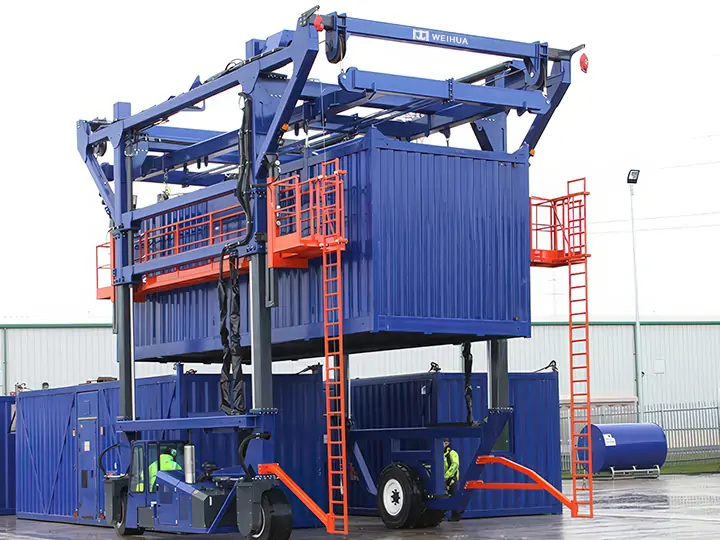
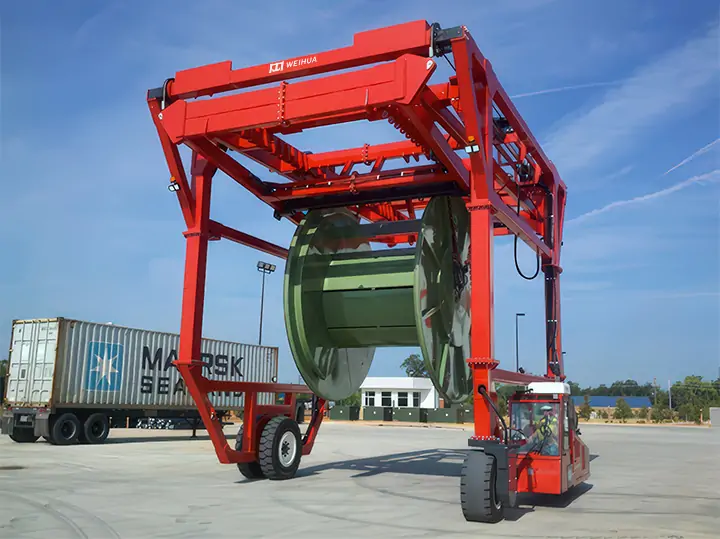
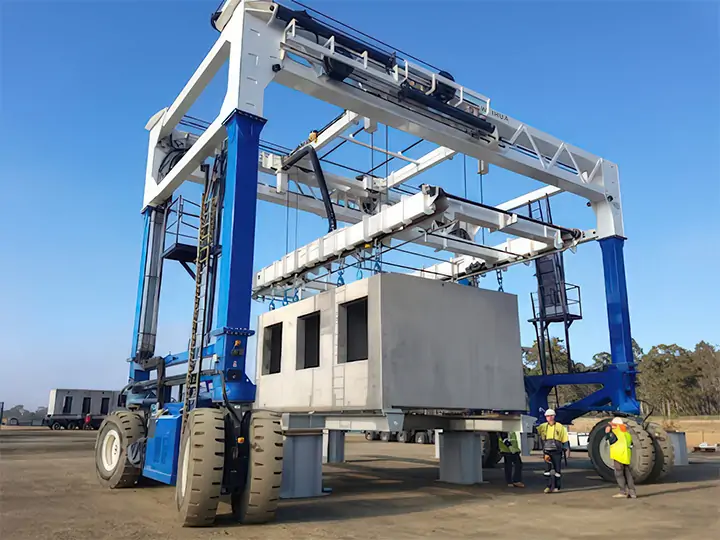
Working in conjunction with quay cranes at the dockside, they quickly receive containers and transport them to the container yard, or retrieve containers from the yard and transport them to the dock for loading onto ships, significantly reducing ship turnaround time in port.
Performing stacking (usually up to 3-4 layers high), transfer, and organization of containers within the container yard, significantly optimizing yard space utilization through high-density storage.
Straddle carriers operate in manufacturing industries. These include the automotive and machinery sectors. They move large components precisely. These components include engines and car bodies. The carriers deliver them from warehouses or buffer zones. Their destination is assembly line workstations.
In large logistics centers or warehouses, straddle carriers handle heavy finished and semi-finished products. They load and unload these goods. They also stack the goods and transfer them across different areas. This activity improves the utilization of warehouse space. It also increases the throughput efficiency of the facility.
Widely used in bridge and building construction sites for lifting, transporting, and precisely installing large precast concrete beams, segments, and steel structures.
In narrow spaces such as tunnels, they transport large segments, equipment, and other heavy materials, with their flexible steering capabilities adapting to complex working conditions.
Used in wind farms to transport and assist in the installation of extra-long wind turbine blades, tower sections, and other large components, solving the problem of moving oversized objects.
In forest areas and processing plants, they are used for transporting and stacking logs and other long, heavy materials.
Used within factory premises to move large machinery, mineral raw materials, or other heavy industrial components.
Determine the required maximum working load, which should include the maximum total weight of the goods being handled (such as containers, precast beams), and allow for a safety margin to account for possible dynamic loads or accidental overloading. The rated load should be at least 10%-15% higher than the maximum daily single-lift weight.
Determine the required lifting height based on the maximum stacking layers and the interface height of the docking equipment (such as trucks, racks). The lifting height must meet the requirements of the highest stacking position and safe working space to avoid affecting operational efficiency due to insufficient height.
The span (gantry width) of the equipment must be able to cover and safely straddle the goods and handling channels. Consider the minimum turning radius and channel width to ensure flexible operation within the given site. Measure the passage width and turning space at the narrowest point of the working area; the maneuverability dimensions of the selected model must match this.
Thoroughly assess the ground flatness, slope, bearing capacity (such as concrete grade, crushed stone base bearing capacity), and durability of the work site. Ground conditions directly affect the stability, passability, and tire wear of the equipment. For soft, uneven, or steeply sloped sites, choose models equipped with appropriate drive and tire types (such as wide-base tires, off-road tires), and foundation reinforcement may be necessary.
Depending on process requirements, consider whether special configurations such as adjustable span, multiple spreaders, rotating spreaders, side shift function, or automatic positioning are needed to enhance the equipment's adaptability to complex tasks. Clearly define possible future operational changes and assess the equipment's adjustability and functional expansion potential to protect long-term investment value.
Drive System: Diesel / Electric / Hybrid / Pure battery drive options available.
Spreader Type: Standard 20'-45' telescopic container spreader (other specialized spreaders can be adapted).
Steering and Tires: Equipped with multi-mode steering system (front-wheel/all-wheel/crab steering), tires can be selected according to ground conditions.
Control Modes: Manual operation from the cab / Remote control / Semi-automatic / Fully automatic control options available.
Frame and Chassis: Structural width, wheelbase, and overall vehicle dimensions can be customized according to your site limitations and accessibility requirements.
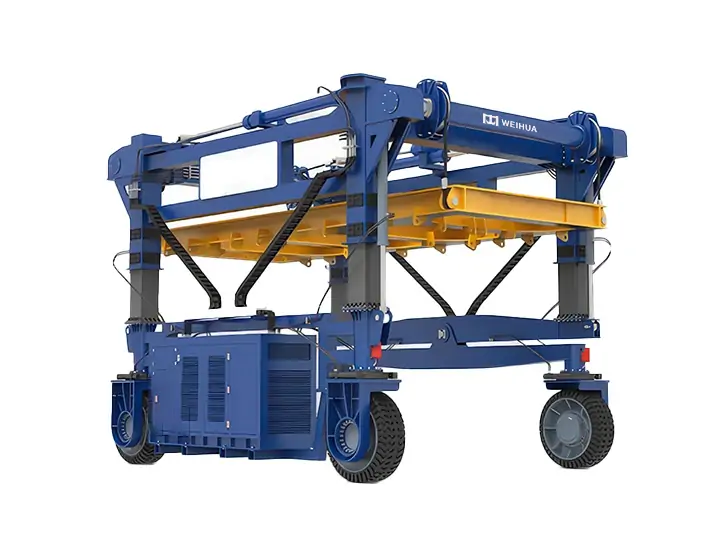
In summary, straddle carriers, with their unique straddle design, superior integrated "self-loading and self-transporting" capabilities, and excellent spatial adaptability, have become a core piece of equipment for improving efficiency, optimizing space, and ensuring safety in modern ports, industrial logistics, and large-scale engineering projects. Looking ahead, straddle carriers will continue to serve as an important vehicle for the automation and greening of logistics, driving related industries towards a more efficient and sustainable future.
For consultations on straddle carrier selection or customized solutions for specific scenarios, please feel to contact us.Grue de Weihua will provide you with professional technical support and services.
Yes. Thanks to their compact design and multi-directional steering capabilities (such as front-wheel steering, all-wheel steering, and "crab" steering), straddle carriers can operate flexibly in limited spaces. The minimum aisle width required for standard models is typically 1.6-1.8 meters, depending on the equipment specifications. When selecting a model, it's crucial to consider its minimum turning radius and external dimensions. It's recommended to request a site suitability simulation or on-site testing from the supplier.
Battery life depends on the battery configuration and workload. Currently, mainstream lithium-ion battery models can operate continuously for 8-10 hours under moderate workload. With a fast-charging system (e.g., charging to 80% in 1 hour), charging during intermittent periods can meet the needs of a single shift. For scenarios requiring 24-hour continuous high-intensity operation, it's recommended to consider a backup battery system or a hybrid model as a transitional solution.
It's recommended to use a Total Cost of Ownership (TCO) approach for comprehensive evaluation, which should include:
Initial investment: Equipment price, optional features, and infrastructure construction costs.
Operating costs: Energy consumption (electricity/fuel), routine maintenance, and replacement of wear parts.
Indirect costs: Labor, efficiency losses due to downtime, and potential safety and environmental costs.
Generally, for applications with a high daily workload (e.g., more than 50 TEUs), although electric straddle carriers have higher initial purchase costs, their lower energy consumption and maintenance costs can result in a lower total cost of ownership over 5 years (approximately 15%-20% less than diesel models), offering better long-term economic benefits.
Container shuttle carriers are versatile and particularly suitable for handling standardized, unitized large goods, mainly including:
Various standard and special-sized containers (20-foot, 40-foot, 45-foot, etc.).
Large industrial components, such as wind turbine blades and towers, prefabricated building modules, and large machinery.
Their flexibility is achieved by changing or adjusting the lifting attachments (such as telescopic arms and rotating hoists) to accommodate different sizes and shapes of goods.
The maintenance intervals for modern container shuttle carriers have been significantly extended. For example, high-quality models can have planned maintenance intervals of up to 1000 operating hours, effectively reducing maintenance frequency and costs. Regular preventive maintenance is crucial for ensuring equipment reliability, extending service life, and maintaining optimal performance.
The price of container shuttle carriers varies considerably depending on factors such as model, power type (diesel/electric/hybrid), lifting capacity, level of automation, and customized configurations. To obtain an accurate quote and cost-benefit analysis, it is recommended to contact equipment suppliers directly and provide detailed operational requirements to receive a tailored solution.
Date :
Date :
Date :
Soumettre une demande
 FR
FR  EN
EN  AR
AR  ES
ES  PT
PT  IT
IT  MN
MN  RO
RO  TR
TR